Patent Law stipulates:
"invention or utility model shall be subject to the content of the claims, and the specification and drawings may be used to interpret the claims."
, in the procedure of patent authorization and infringement dispute litigation, it is a basic work to determine the scope of protection of the claim. For patent writers, in order to write high-quality application documents, in addition to making the application documents meet the requirements of "authorization", they must also move closer to the standards of "difficult to invalidate" and "easy to protect rights. The realization of the latter two points is inseparable from the correct understanding of the rules of interpretation of claims in practice. As for how to interpret the claims, the following is a combination of recent cases I have seen,outline a few common rules.
1. If the specification has a special definition, it shall be specially defined.
Patent Examination Guidelines provide that:
", if the specification indicates that a word has a specific meaning, and the scope of protection of the claims using the word is clearly defined enough due to the definition of the word in the specification, this situation is allowed."
The first paragraph of Article 3 of the Interpretation of the Supreme People's Court on Several Issues Concerning the Application of Law in the Trial of Cases of Patent Infringement Disputes stipulates:
"people's court may interpret the claims by using the relevant claims in the specification and drawings, the claims, and the patent examination files. Where the specification specifically defines the terms of the claims, they are specifically defined therefrom."
Under certain circumstances, if the description indicates that the term has a specific meaning, or if the patent applicant or patentee makes statements in the patent examination files and reexamination, invalidation, administrative proceedings at the patent application stage, or if the term is specifically limited by the determination made by the relevant administrative or judicial authorities, it shall be understood in accordance with the specific meaning.
Case 01
In Reexamination Decision No. 40682, regarding how to understand the meaning of the two terms "actual stage" and "ideal stage" in the claims, it was decided that the involved patent specification clearly stated on page 4, lines 6-7 and lines 18-19, "The actual stage is through monitoring the crankshaft and thus the wheel passing through the reference angle & theta; and the time of rotation to determine" "the ideal stage is the stage in which the crankshaft will rotate a given angle & theta; without any interference", it can be seen that,the description clearly indicates the specific meaning of the two, the scope of protection of the claims is also clearly enough because the description of the above two words is clearly defined., therefore, the meaning of these terms should be understood in accordance with the above definitions given in the specification.
2. If the specification is not specifically defined, the usual meaning in the art shall be adopted for interpretation.
Usually, in the patent authorization procedure, the interpretation of the claim is taken.Principle of maximum reasonable explanation, that is, based on the written record of the claims, combined with the understanding of the specification, the claims are reasonably interpreted in the broadest sense.
, if the description does not specifically define the meaning of the claim terms, in principle, the general meaning that can be understood by those of ordinary skill in the art after reading the claims, the description and the drawings should be adopted, and the description or the drawings should be avoided as far as possible.
In the case involved in the (2020) Supreme Court's final judgment No. 253, the claims of the patent involved limit "both the outside of the internal pressure tube and the winding structure wall."packagehave an outer layer ". For the understanding of the word "package", the patentee claims that the word "package" means "contact", that is, the outer coating of this patent is in contact with both the internal pressure tube and the wound structure wall.
held that,
①Neither the specification nor the drawings of this patent describe or limit the meaning of "package" as "contact" claimed by the patentee..
②This patent specification is also shown in Figure 1.clearly shows the technical solution of an embodiment.is, the outer cladding 3 is only in contact with the winding structure wall 2 and is not in contact with the inner pressure tube 1 at the same time, which is inconsistent with the above-mentioned assertion of the patentee.
③accordingthe ordinary understanding of those skilled in the art on the meaning of the text,disposed outside a two-layer structure that is disposed in sequence is consistent with the meaning of "wrapping" outside the two-layer structure even if it is not in contact with the innermost layer structure.
In summary, the first and second instance judgments do not support the patentee's claims.
Case 03
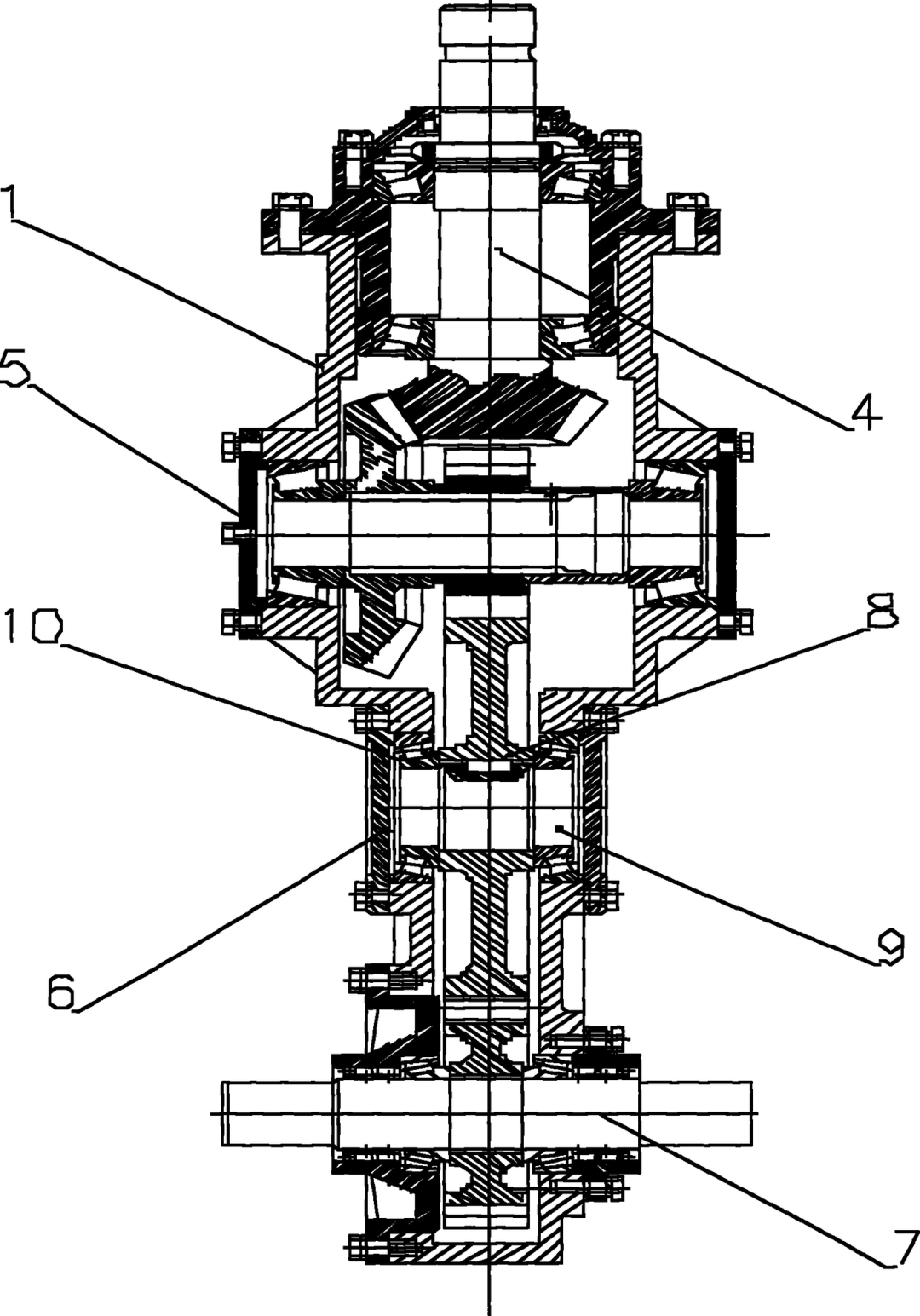
In the cases involved in (2020) Supreme Law Zhixing Final Judgment No. 74, the claim limits"Three-axis bearings (10) are installed on both sides of the housing (1), the three-axis (9) is installed on the three-axis bearing (10), the three-axis gear (8) is installed on the three-axis (9),The three-axis gland (6) is fixed on both sides of the box shell (1), used to adjust the axial position of the three-axis bearing (10) ".
In this case, all parties agree that evidence 5 clearly discloses the technical content of arranging tapered roller bearings on the shaft of the gearbox, and it can be known from the drawings that it is arranged on both sides of the box body 1, that is, evidence 5 essentially discloses The patent's technical features of "the bearing is installed on both sides of the box shell" and "the shaft is installed on the bearing.
's case is that"The gland is fixed on both sides of the box shell"the understanding of "both sides.
Court of First Instance (Beijing Intellectual Property Court) held that "the gland is fixed on both sides of the box shell" refers to "two outer sides", so evidence 5 is not disclosed"triaxial gland is fixed on the two outer sides of the box body shell":
"For the three-axis gland (6) described in this patent is fixed on both sides of the box shell (1),only from the literal meaning, it can usually be understood that the gland is located on the two outer sides of the box shell, or contained in the two sides of the box shell.At this time, the claims should be interpreted in combination with the description and the drawings, and technical solutions that cannot achieve the purpose and effect of the invention should not be interpreted into the protection scope of the claims. In this case, the background technical part of this patent specification records that "currently known rotary tiller gearbox assembly, the three-stage transmission mechanism adopts bearings installed inside the transmission gear, and the three-axis and three-axis glands are installed in the holes on both sides of the gearbox housing. this structure has defects such as high cost, unstable performance, easy damage to the gearbox housing, etc." the specification records that the technical effect of this patent is "reasonable structure and stable performance, greatly reduce the failure rate of the machine, reduce the cost of three packages, and the operation is safe and reliable", at the same time, from the description of the drawings can be seen, the three-axis gland (6) is located on the outside of the box shell (1), therefore,According to the purpose of the invention of this patent and in conjunction with the drawings of the description,to claim 1 is fixed on both sides of the box body shell (1), and the positional relationship between the gland and the box body shell should be that the gland is located on both outer sides of the box body shell, rather than contained on both sides of the box body shell, thereby bringing about the technical effect of preventing debris, soil and the like from entering the gearbox to improve the stability of the gearbox and reduce the failure rate. However, the end cover 4 in evidence 5 is located in the inner hole of the box body 1, which is basically consistent with the prior art described in the background section of this patent. Although the end cover 4 also plays a role in facilitating the adjustment of bearing clearance, compared with the triaxial gland located outside the box body shell in this patent, it cannot prevent debris from entering the gearbox, and in evidence 5, a dust cover 2 is also provided to solve the problem of debris entering, it can be seen that, on the basis of the disclosure of evidence 5, those skilled in the art can not realize that the end cover is arranged outside the box to prevent debris from entering, that is, evidence 5 does not give the end cover is arranged outside the box to improve sealing, reduce the failure rate of technical enlightenment."
second instance (the supreme people's court) held that,"The gland is fixed on both sides of the box shell"does not mean "two outsides":
1. Improper interpretation of the claims in the original trial
"First of all, the patent claim 1 defines that "the three-axis gland is fixed on both sides of the box shell for adjusting the axial position of the three-axis bearing", whereinthe text meaning of "both sides of the box shell" is clear, and there is no ambiguity per se for those of ordinary skill in the art.Secondly, in addition to the record that "the three-axis gland is fixed on both sides of the box body shell", the patent claim 1 also records that "the three-axis bearing is installed on both sides of the box body shell",In the absence of special instructions, the above-mentioned two "two sides of the box shell" in the same claim should not be interpreted inconsistently.and as far as the patented technical scheme of this case is concerned, ordinary technicians in the art all know that the three-axis bearing will not be installed on the two outer sides of the box body shell. However, according to the drawings of this patent, the three-axis gland replaces the box body shell with the gland. Here, the concept that the three-axis gland is not installed on the outer side of the box body shell does not exist. Therefore, when implementing the technical scheme, it can be understood that "the three-axis bearing is installed on both sides of the box shell" and "the three-axis gland is fixed on both sides of the box shell" in the technical scheme, only the relative installation position relationship of the three-axis bearing and the three-axis gland on both sides of the box shell is clear, and will not be ambiguous or ambiguous.The court of first instance interpreted the two sides of the box shell in the claim as improper on the two outer sides under the circumstance that there was no ambiguity in the meaning of the term of the claim, which was also inconsistent with the description and the accompanying drawings."
2. Inappropriate determination of technical effects in the original trial
"Whether the technical defects described in the background technology of the specification are actually solved by the patented technical solution,shall make judgments based on the distinguishing technical features and technical means recorded in the claims.. According to the background technical records of this patent specification, the original court interpreted the three-axis gland as being located on both sides of the box shell, and interpreted the three-axis gland as being located on both outer sides of the box shell, and identified this as bringing the technical effect of blocking debris, soil, etc. from entering the gearbox to improve the stability of the gearbox and reduce the failure rate. Obviously, the two lateral interpretations are wrong,"blocking debris and soil" is not recorded in the specification, the technical effect is not supported by the corresponding differentiated technical features or technical means, and is not the technical effect brought by the differentiated technical features to the technical scheme. The original court made an error in determining the technical effect."
3.interpretation to be consistentPurpose of Invention
In the process of interpretation, in order to accurately understand the purpose of the invention, the technical scheme that does not meet the purpose of the invention should not be interpreted into the claims, nor should the technical scheme that can solve the technical problems of the patent and achieve the purpose and technical effect of the invention, which can be obtained by those skilled in the art without creative labor, be excluded from the scope of patent protection.
In the case involved in the (2021) Supreme Law Know Minzhong Judgment No. 1659, claim 1 of the patent involved describes that "the gap between the receiving part and the cover part is below the wire diameter of the torsion spring", and there is a dispute over the understanding of the word "gap" in it.
The judgement found that:
claim 1 of the patent in question defines that "in the opening of the receiving part, a cover member covering the opening is arranged",Combination Instructionthe [0020] paragraph "by using the cover part to cover the storage part, even in the case of damage to the torsion spring, fragments are left in the storage part, which can reduce the risk of fragments falling to the outside of the storage part", it can be seen that the above technical features of the "gap" should refer to the gap formed by the cover part covering the storage part. Regarding "the gap is below the wire diameter of the torsion spring", yesrealizing the technical effect of "in the case of breakage of the torsion spring, the fragments are also left in the storage part, thereby reducing the risk of the fragments falling out of the storage part".
In the case involved in (2020) the Supreme Court's final judgment No. 403, claim 1 of the patent in question defines: "On the transverse detection arm (103), the two angled ray surface areas on which X-rays are emitted, a ray detector is evenly installed, and the ray detector ismounting bracket can be adjustedto ensure that the detection surface of the ray detector is facing the X-ray to make the detected X-ray signal the strongest."
, since the position, structure and connection relationship of the term "mounting bracket" are not described in this patent specification and the attached drawings, the interpretation of the term is controversial.
The first instance (Beijing Intellectual Property Court) held that the mounting bracket should be understood as the connecting part of the ray detector and the horizontal detection arm:
①literally,The "mounting" herein refers to the mounting relationship between the ray detector and the transverse detection arm, and the "mounting bracket of the ray detector" shall refer to the connecting part between the ray detector and the transverse detection arm, rather than the connecting part between the ray detector and the main beam.
②is generally known to those skilled in the art., when the detection surface of the ray detector is perpendicular to the main beam of rays emitted by the radiation source, the ray signal received by the ray detector is strongest and truest. Only when the detection surface of the ray detector is perpendicular to the main beam of rays emitted by the radiation source, can it be "ensured that the detection surface of the ray detector is facing the X-rays so that the detected X-ray signal is the strongest".If the transverse detection arm or the transverse detection arm and the mounting support are regarded as the "mounting bracket of the ray detector" described in claim 1 of this patent", then according to the patent claim 8 and the corresponding content of the specification, the horizontal detection arm has an adjustment device composed of a horizontal adjustment bolt and a vertical adjustment bolt, and the adjustment of the horizontal detection arm adjustment device can only achieve the overall displacement of the ray detector array, and cannot adjust the detection surface of a single ray detector, that iscannot "ensure that the detection surface of the ray detector is facing the X-rays so that the detected X-ray signal is the strongest".
③ The patent claims and the specification have no special description on the "mounting bracket of the ray detector", and the accompanying drawings of the patent specification in question are not marked with the "mounting bracket of the ray detector". Accordingly, this should be interpreted in conjunction with the general understanding of one of ordinary skill in the art. in the context of patent claim 1,Combined with the patent specification and drawings involved, those skilled in the art usually understand the "mounting bracket of the ray detector" as the connecting part between the horizontal detection arm and the ray detector..
Second instance (the Supreme People's Court) held that "mounting bracket" should refer to the horizontal detection arm:
①In combination with the records of claim 8 of the patent and the embodiment of paragraph [0028] of the patent specification that "the transverse detection arm can be translated and swung by adjusting the transverse adjustment bolt", and in combination with the relevant drawings, it can be seen that the transverse detection arm can be translated and swung by adjusting the transverse adjustment bolt, and the relative position of the transverse detection arm and the vertical detection arm can be adjusted by adjusting the longitudinal adjustment bolt, namelyThis patent adjusts the ray detector array by adjusting the direction position of the transverse detection arm as a whole, so that the detection surface of the ray detector is facing X-rays to make the detected X-ray signal the strongest.. In addition, according to the contents disclosed in claim 4 and paragraph [0023] of the specification of the present patent,This patent is by "adjusting the vertical detection arm", that is, the overall adjustment of the detector array on the vertical detection arm, "to ensure that the detection surface of the ray detector is facing the X-ray so that the detected X-ray signal is the strongest". From the reference relationship between claim 1 and claim 4, the coordinated action relationship between the horizontal detection arm and the vertical detection arm, and the specification [0024] "All collimators, horizontal detectors and vertical detectors are symmetrically arranged into two groups according to the angle of double view, and all are designed with adjustment devices to ensure that the emitted rays and the obtained signals are consistent with the angle of view, to ensure that the signal obtained is the strongest and the most true... Finally, to ensure the accuracy and efficiency of the detection system" content can be known,The horizontal detection arm and the vertical detection arm should be technical means that echo each other in structure, cooperate with each other in function, and have basically the same effect., the adjustment mode of the horizontal detection arm should be the same as the overall adjustment, that is, this patent is through the adjustment of the horizontal detection arm, to ensure that the detection surface of the ray detector is facing the X-ray so that the detected X-ray signal is the strongest, it can be seen that the above-mentioned "mounting bracket" should refer to the horizontal detection arm.
②From the purpose of the invention of this patent., only by adjusting the ray detector array through the horizontal detection arm, can it be easily and quickly realized that "the detection surface of the ray detector is facing the X-ray", and then "the detected X-ray signal is the strongest", in order to achieve the pursuit of this patent The invention purpose of "simple structure, low cost, fast inspection speed.on the contrary, if the "mounting bracket of the ray detector" is understood as the connecting component between the ray detector and the transverse detection arm, each mounting bracket needs to be adjusted to achieve the technical effect of "ensuring that the detection surface of the ray detector is facing the X-rays and the detected X-ray signal is the strongest", which is not only difficult to achieve technically, but also extremely costly and complex in structure, obviously does not meet the patent "simple structure, low cost, fast inspection speed" of the invention..
③Starting from the common sense of production and installation of scanning imaging devices, the position of the ray detector is installed and fixed after strict calculation, so as to ensure that the ray detector faces the direction of the radiation source, rather than being installed and fixed arbitrarily. Since the ray detectors are all fixedly mounted on the detection arm, and all the ray detectors are coplanar, it is only necessary to adjust the fixed ray detector array on the transverse detection arm and make it face the X-ray sector, so as to "ensure that the detection surface of the ray detector faces the X-rays so that the detected X-ray signal is the strongest", without the need for single adjustment.
only a few common rules or principles of claim interpretation are briefly listed in this paper, in fact, there are still many disputes about the scale of claim interpretation in practice. In different procedures, different collegiate groups or courts, and different periods of time, there may be some differences in the criteria for determination. For example, in the aforementioned case 05, even though the perceptions of the court of first instance and the court of second instance at the level of principle seem to be the same, there are still certain differences in the determination of the facts in this specific case, so that in this case, a very different determination result was obtained.
Generally speaking, at present, in the authorization and confirmation procedures (especially the State Intellectual Property Office), the principle of maximum reasonable interpretation is relatively strictly followed. Except for the specific definition in the specification, the contents of the specification and drawings are avoided to explain the claims. This is mainly based onprompting the applicant to improve the patent application documents and improve the certainty of the scope of patent protection.. In infringement litigation, the interpretation of the claims is relatively strict, and the description and drawings, the relevant claims in the claims, and the patent examination files can be used as needed to explain, so as to prevent the overly broad interpretation from making the scope of protection of the claims unduly expanded.
In order to avoid unnecessary trouble in the process of confirming or exercising rights, attention should be paid to ensuring the clarity of the meaning of the terms in the claims during the writing of the application documents. Specifically, the following points need to be noted:
1. Improve the standardization of the terms of the claims and use the general technical terms in the art as much as possible. If you need to use self-coined words or some terms that may be ambiguous, you need to clearly define them in the specification.
2. For the features related to the structure, the parts mentioned in the claims are reflected in the drawings as far as possible and marked with reference signs, so that what exactly the part refers to can be correctly determined.
3. Correctly summarize the technical effects that can be achieved by the technical features, and avoid unnecessary restrictions on the scope of interpretation of the claims due to the technical effects that cannot be achieved by the stacking scheme.
(This article only represents the author's personal point of view, if there is any fallacy, welcome criticism and correction)
-Full text-